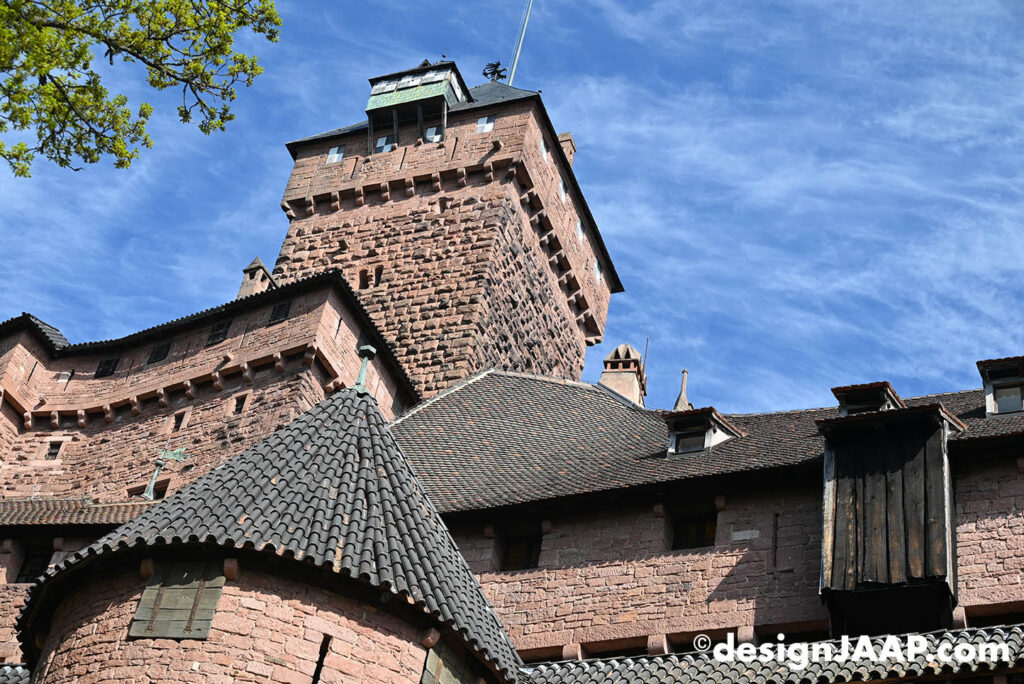
The Château du Haut-Koenigsbourg sometimes also Haut-Kœnigsbourg, is a medieval castle located in the commune of Orschwiller in the Bas-Rhin département of Alsace, France. Located in the Vosges mountains just west of Sélestat, situated in a strategic area on a rocky spur overlooking the Upper Rhine Plain, it was used by successive powers from the Middle Ages until the Thirty Years’ War when it was abandoned. From 1900 to 1908 it was rebuilt at the behest of the German kaiser Wilhelm II. Today it is a major tourist site, attracting more than 500,000 visitors a year.
The Buntsandstein cliff was first mentioned as Stofenberk (Staufenberg) in a 774 deed issued by the Frankish king Charlemagne. Again certified in 854, it was then a possession of the French Basilica of St Denis and the site of a monastery.
It is not known when the first castle was built. However, a Burg Staufen (Castrum Estufin) is documented in 1147, when the monks complained to King Louis VII of France about its unlawful construction by the Hohenstaufen Duke Frederick II of Swabia. Frederick’s younger brother Conrad III had been elected King of the Romans in 1138, to be succeeded by Frederick’s son Frederick Barbarossa in 1152 and, by 1192, the castle was called Kinzburg (Königsburg, “King’s Castle”).
In 1479, the Habsburg emperor Frederick III granted the castle ruins in fief to the Counts of Thierstein, who rebuilt them with a defensive system suited to the new artillery of the time. When in 1517 the last Thierstein died, the castle became a reverted fief and again came into the possession of the Habsburg emperor of the day, Maximilian I. In 1633, during the Thirty Years’ War in which Catholic forces fought Protestant armies, the Imperial castle was besieged by Protestant Swedish forces. After a 52-day siege, the castle was burned and looted by the Swedish troops. For several hundred years it was left unused and the ruins became overgrown by the forest. Various romantic poets and artists were inspired by the castle during this time.
The ruins were listed as a monument historique of the Second French Empire in 1862 and were purchased by the township of Sélestat (or Schlettstadt) three years later. After the Franco-Prussian War of 1870 to 1871, the region was incorporated into the German Imperial Territory of Alsace-Lorraine and, in 1899, the citizens granted what was left of the castle to the German emperor Wilhelm II. Wilhelm wished to create a castle lauding the qualities of Alsace in the Middle Ages and more generally of German civilization stretching from Hohkönigsburg in the west to (likewise restored) Marienburg Castle in the east. He also hoped the restoration would reinforce the bond of Alsatians with Germany, as they had only recently been incorporated into the newly established German Empire. The management of the restoration of the fortifications was entrusted to the architect Bodo Ebhardt, a proven expert on the reconstruction of medieval castles. Work proceeded from 1900 to 1908. On May 13, 1908, the restored Hohkönigsburg was inaugurated in the presence of the Emperor. In an elaborate re-enactment ceremony, a historic cortege entered the castle, under a torrential downpour.
Here is a photographic impression of the Château du Haut-Koenigsbourg .