Lions are big cats, recognisable by their muscular build, golden brown coat and long tail with a dark plume at the end. Males also have a thick mane around their neck. Females do not have this.
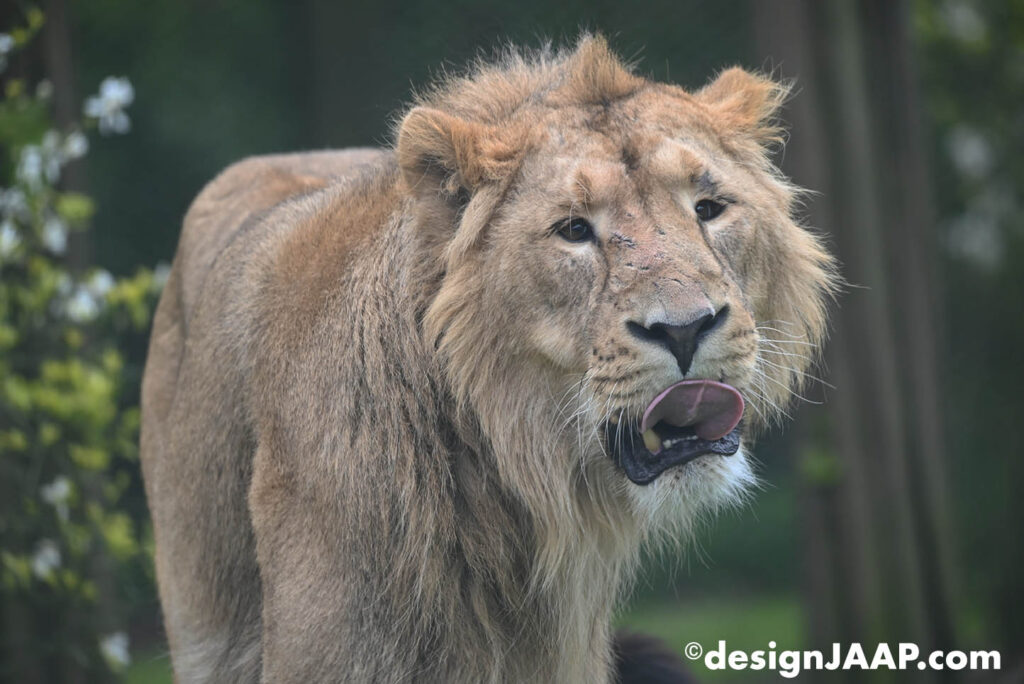
Male Asian lion (Panthera leo persica)
The difference between Asian (Panthera leo persica) and African (Panthera leo leo and Panthera leo melanochaita) lions can also be seen in the mane: it is slightly less impressive than that of its African relatives. Asian lions are also generally slightly smaller and have a fold of skin along the length of their lower abdomen.
The Asiatic lion used to be found from Persia (Iran) to eastern India. Nowadays, they can only be found in the Gir Forest National Park in western India. Unlike their African relatives, who hunt on open plains, Asiatic lions live mostly in forests.

Female Asian lions (Panthera leo persica)
Asiatic lions usually hunt alone. They can hide well in the wooded environment where they live. When an unsuspecting boar, deer or antelope comes too close, the lion pounces to seize its prey.
By hunting these animals, the lion ensures that there are not too many herbivores in the area. This prevents the forest from being stripped bare. That is why large predators such as lions are very important for their habitat.
Unlike other cats, which usually live alone, lions are very social animals. Usually, one male guards a group of females and their cubs. Although these “prides” of African lions often consist of 4 to 6 adult females, Asiatic lion prides often only have 2 to 3 females.
Sometimes two or three males team up to guard several groups of females. Together, they have a better chance of warding off wandering males. The social structure of lions is very complex, and scientists are discovering more and more about it.
Asiatic lions usually give birth to two or three cubs, which weigh around 1.5 kilograms at birth. The mother first hides in a safe place with her cubs before taking them to the pride. There, the cubs are cared for by all the females: sometimes they even suckle from other lionesses.
Lion cubs learn a lot from each other and their parents. They play to learn how to fight and run. When they are big enough, they watch their parents hunt. This is how they practise important survival skills. After 2 to 3 years, they leave the pride where they were born in search of a new pride.
Around 1900, the number of wild Asiatic lions reached an all-time low. At that time, there were fewer than 20 animals left. Since then, hunting lions has been banned and their habitat has been increasingly protected. As a result, the number of lions in India is rising again. In 2017, there were already 650! Although the Asiatic lion is doing better and better, most animals are descended from the same ancestors. This means that the risk of inbreeding among Asiatic lions is quite high. The status of the Asiatic lion in the wild is therefore still “Endangered”.
Here is a photographic impression of Asian lion (Panthera leo persica) in Rotterdam Zoo.